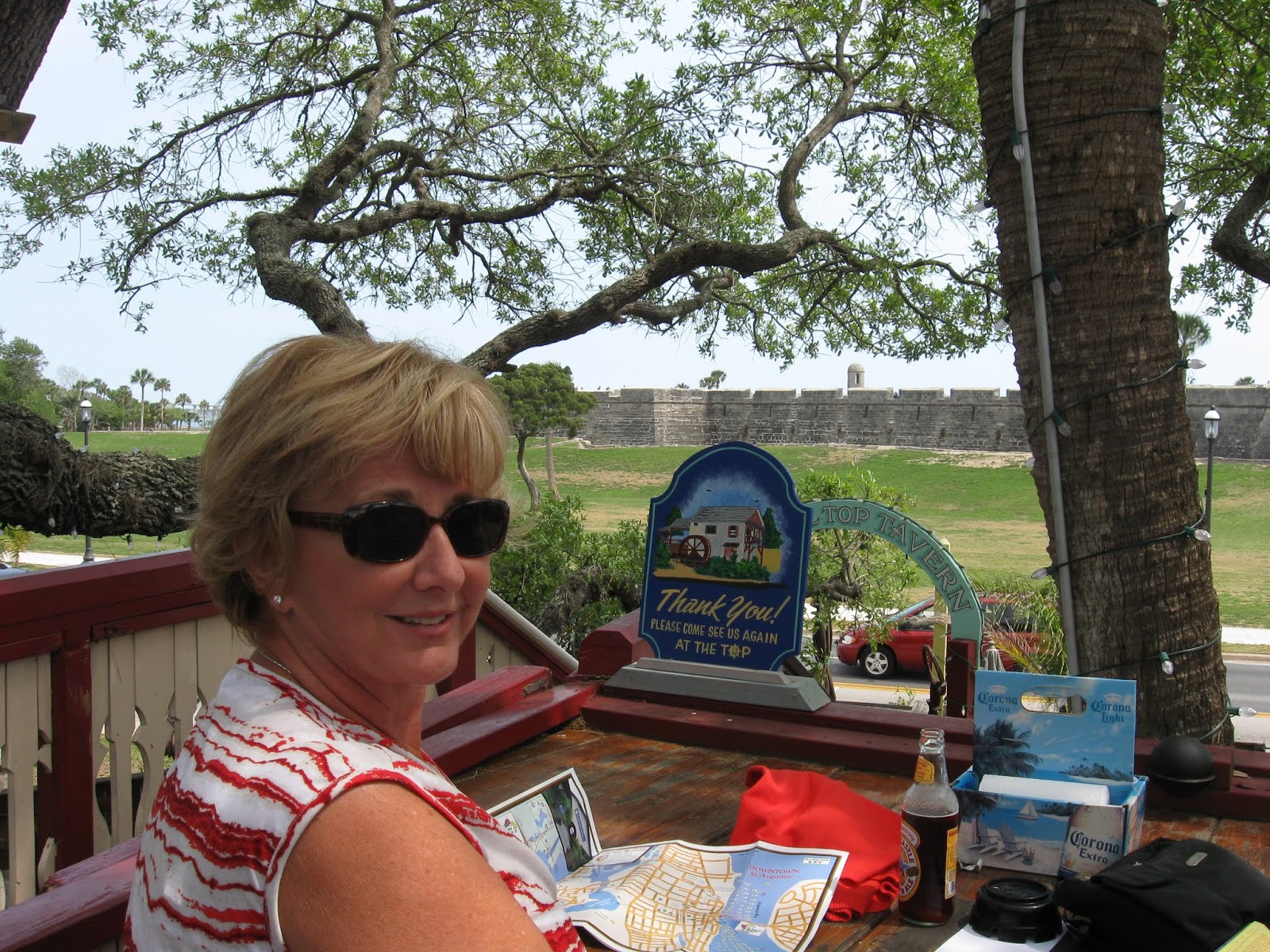
St. Augustine has a rich and varied history like most cities on the East coast. It is, though, the oldest city in what is now the USA having been established on September 8, 1565. This was 42 years before Jamestown. Believe me, the locals are quick to point that out and that fact is the basis of the beginning of ever tour group that you see.
We arrived at St. Augustine on April 2, 2013. That would be 448 years after the original settling of the town. In between that time the city was held by the originating Spanish as it was established by Don Pedro Menendez de Aviles. The fort that was built was called Castillo de San Marcos.
This was built around 1672 and some of the original walls still exist.
The walls at the fort as well as around the town are built with a substance called coquino. This is a cement like compound made of the residue of burned oyster shells, sand, water, and chunks of shells mixed in. It makes a long lasting structure. In some places the walls of the fort are 12 feet thick at the base narrowing to a mere 7 feet along some of the ramparts.
Sir Frances Drake and the English took over the town after a long bombardment in 1586 where it remained in British hands until after the Revolutionary War. The fort was used by the British as a staging area for battles up and down the coast and as a prison as well.
With a city this old and well preserved there are MANY historical sites to see and visit. One of the nicest was the old Alcazar Hotel built in the early 1800's and is now a museum and used as the City Hall for St. Augustine.
The oldest street in America is Aviles Steet...
which today houses a number of restaurants, shops, and homes which provide glimpses of the architecture of days gone by.
Below are a few of the old doors, windows, and entryways from days gone by.
When we pass by some of these doors, we always wonder what is behind them.
A few that were "architecturally cooperative", helped provide the answers.
Back at the marina there is always activity. The city of St. Augustine is building an addition to their docks where a portion will act as a breakwater to some of the waves that form from strong northern winds. One afternoon a construction barge stopped by to drop off some materials ...
only to find itself in a very compromising position as it came close to crunching up several boats as it maneuvered around.
We were very happy to be one of the smaller boats in the harbor that day.
On Thursday night Jeff and Kathy returned to take us to dinner as they were completing the driving portion of their vacation. On Friday night we enjoyed the Friday night art walk in the city. That finally provided us the opportunity to see some manatees whose viewing so far had eluded us.
As boaters you always see clever names that people have selected to name their boat. This in conjunction with the notion that "happy hour" starts at five o'clock provided this boat owner with the name of their boat. I think they could be thought of as "party central" when they are out cruising.
Nautical Word For The Day: [from seatalk.info]
Painter:
1. A light rope attached to the bow of a small boat as a towing line or as a bow line.
From Great Loop Jargon:
2. Having had a lot of experience at this one, it is the term for the person on the other end of the brush that is applying paint to the wall and is often accompanied by the phrase...
" Yes, dear, I'll be sure to touch that up".
After leaving Titusville and the Kennedy Space Center the next two days were dedicated to getting to St. Augustine. While each day is different in what you see, this stretch was less eventful than most. Here we have one last view of the Vehicle Assembly Building from the ICW as we head north.
Our departure routine for us when we leave dockside is that Bob is at the controls and Debi is providing clearance information with regards to other boats and structures. You just don't want to meet other folks you had no intention of meeting just because you "bumped" into them. So far so good.
After we depart, Debi usually puts away all the fenders and lines for the day.
Passing under bascule bridges has become a bit of a routine by now as well.
We find we can pass under almost all of them without requesting an opening especially if the VHF antenna is lowered. Each bridge has a "clearance board" that tells you how much space you have under the bridge for your boat.
Many of the bascule bridges are being replaced by larger and much taller fixed bridges that typically provide about 65' of clearance under them. They have turned many of the old bridges into fishing piers.
Some of the bridges have even got caught up in the expenditure for artwork associated with public projects. This one has aquatic scenes stenciled into the cement piles supporting the bridge. I am sure the local manatees are impressed!
At this location there was a construction barge repairing the wooden "fenders" that are on each side of the designated passage way. These fenders act as a breakwater from wakes of the boats as they pass under the bridges... supposedly at near idle speed. When there is a barge in the passageway, it makes what feels like a narrow space seem much more narrow yet!
Of course as you transit the ICW you are likely to run into many different types of boats including small tour boats and yachts that look like small tour boats that have a lot of room on them.
Along the way when you get out of the city areas the terrain varies tremendously.
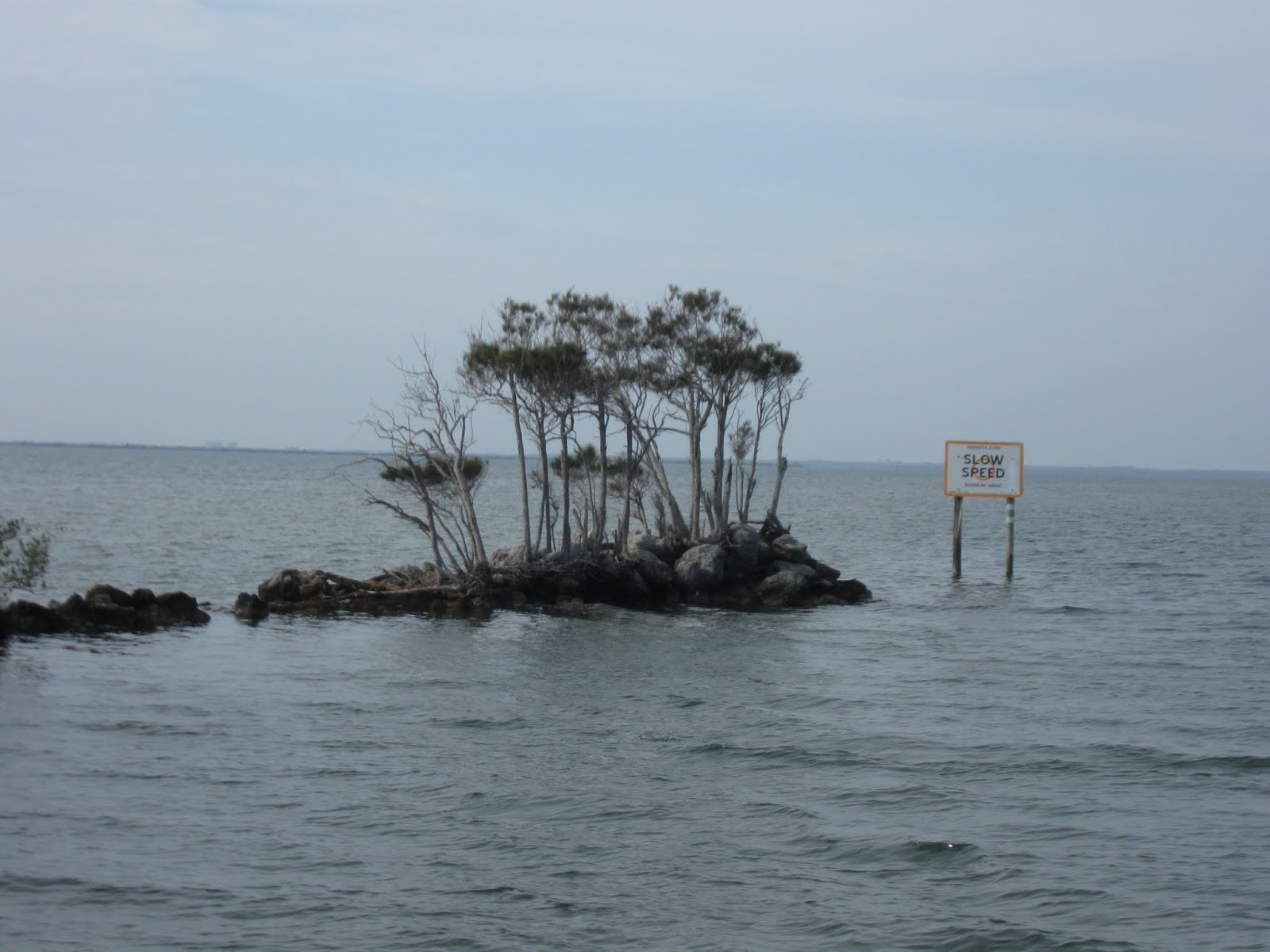
Very near the ICW you will find very shallow islands with trees growing out of the water...
and at low tides the huge sandbars get exposed. They do provide a spot for the shorebirds to search for for food. We have often seen huge flocks scouring these newly exposed beaches. These grounded areas are not that far from the boat as we pass by them.
After arriving in Daytona Beach on April 1st, we moved on to St. Augustine on April 2nd for a four day stay.
Nautical Word For The Day: [from seatalk.info]
Yawl;
1. A two masted sailboat having the main mast stepped forward of the beam and a small mizzen stepped aft of the rudder post.
From Great Loop Jargon:
2. A southern term that roughly translates into "you all" and is part of every greeting when you meet or talk to someone from the South.
America's Great Loop Cruising Association [AGLCA] is an organization whose members are interested in doing or have done the Great Loop.
There are various categories of membership based on your participation in the group. There are those in the planning stage [wanna be's], there are those in progress, there are those who have completed, and there are those who have completed the Loop two or more times.
Once you have started the trip you get to fly a white burgee. This identifies you to other loopers as you progress around the loop.
But once you have completed the Loop or "crossed your wake" as they say in AGLCA circles, you get to fly the gold burgee. Flying gold is the goal of every looper. Well, our friends, Bob and Cathryn, from Olalla reached gold status on March 13, 2013. We again congratulate them for this accomplishment.
We met Bob and Cathryn by coincidence as they see the dentist next door to where Bob S practiced. When they explained that they could not make a 6 month check-up as they were going to do the Great Loop, their dentist explained that we were intending to do the same thing. After an exchange of emails, we met for dinner at Bob and Cathryn's home. The rest is history.
We have been following their blog for the year plus that they have been in preparation for as well as under way on this Great Loop trip. During this time we have been in communication with them about our preparations about
a whole variety of topics. They have ALWAYS been willing to share their knowledge with the new guys.
As they were getting close to completing their loop, we were just starting. We tried to meet up a number of times before they left Florida to return home to Olalla but could not do so while they were underway.
But we did manage to do so as they were leaving Florida. They had their truck all packed and were on their way home. So while we were in Titusville, they took the time to pull off the freeway and come to the marina to see us and wish us well.
As loopers do, they asked us if we needed anything before they left with their "stuffed to the gills" truck. Since we had already planned to go to lunch, the four of us crammed ourselves into the "room for two" front seat with Cathryn wedging herself into the backseat between the clothes and boxes.
Debi sat on Bob's lap while Gold Looper Bob drove. I know it was a lot easier to squeeze in before lunch rather than afterwards. Despite wanting to get back on the road home, they were gracious enough to take us to a nearby grocery store for us to re-provision our supplies and ship's stores. They just said, "That's what looper's do".
They have since returned home and are hopefully planning their next adventure. We wish them well in whatever they choose to do and sincerely thank them for all the help that they have provided us and the time they spent helping out us AGLCA "rookies".
Nautical Word For The Day: [from seatalk.info]
Skipper:
1. Master of a ship; Also Captain.
From Great Loop Jargon:
2. Describes both Bob and Cathryn as they shared the duties of the "skipper" on their boat "Next To Me".
For many years Debi, the adventurer and certified bungee jumper that she is, has been fascinated with space travel. At one point a few years back she almost enrolled in the one week Adult Space Camp program that NASA ran at the time. But... she didn't. So being this close to the Kennedy Space Center, a visit there was a must do side trip. That was arranged for Sunday, March 31st.
After a half hour taxi ride from the Titusville Marina, we arrived at the KSC Visitor Complex.
Because we had a little time before our scheduled bus tour of other sites we strolled around the grounds. Here we checked out the Rocket Garden...
where they have original and replicas of the rockets that took Alan Shepard into space, the first sputnik rocket, and a number of the others of the early space program. They are displayed in the upright launch position so it looks like they just grew right out of the ground.
Nearby was the actual original catwalk that the early astronauts walked across as they were being loaded into their space capsules.
There was an actual formerly used capsule there to crawl into to get a feel for how tight the quarters were for the occupants. You can not be claustrophobic and be an astronaut too.
We then boarded our bus...
to take us on a tour of of the other facilities that those of us who have watched the launches, are familiar with. These included the Vehicle Assembly Building.
We could see it for miles as we were boating up the Florida coast. To stand next to it and then tour portions of the inside was quite an awesome experience.
They had mock up models in place to show some of the stepwise assembly process.
Other steps were depicted with large drawings and photographs.
The next stop was the Launch Control Center with nearby buildings for the press and television people.
It was just what we imagined it to be but seemed much smaller in size than expected. There was a simulated launch being conducted with the traditional countdown as we watched the screens.
Next was a quick drive by of the Shuttle Landing Facility. The runway is about 3 miles long. A photograph from space shows that it is fairly easy to locate if the weather is clear.
LC 39 A and LC 39 B are two of the launch pads used for the firing of the space rockets to carry the space vehicles. From a distance they look like big erector sets all set up and ready for a kid to play space games.
The tower to the right is filled with water that is used to cool the launch area at liftoff.
Nearby there are several viewing platforms. It looks like this turtle was a little late for the last one. Well, he is a turtle after all.
One of the most impressive displays is the Apollo/Saturn V rocket building. OMG! The size of that rocket is immense and that does not begin to describe it.
The rocket was displayed in a horizontal position. There was an explanation for the function for each section. Very impressive to say the least.
Need a lift???
After a quick lunch which was as advertised... from the moon and tasted like rocks...
we returned to the main KSC campus for the rest of our tour. The first stop included two 3-D IMAX movies complete with appropriate eye wear.
The movies were "Hubble 3-D" and "Space Station 3-D". Both were fantastic. It was fun to watch some of the kids reach out to try to touch a 3-D star that was floating their way. [Sorry... can't photograph that one!]
The last part of the tour for us was the Shuttle Launch Experience.
This took you through a simulated launch process and put you in mocked up capsule strapped into a seat. Of course they tipped you back a bit and put a few G-forces on you as you lifted off and then did the reverse when
you did your re-entry. As with all of the other launches that day, there were no mishaps and everyone landed safely.
The day at KSC was very inspiring. Here is the Admiral once again attempting to move heaven and earth. She has become very good at it! I know that she enjoyed the day a lot though.
A day at the KSC would not be complete without the obligatory stop at the gift shop. While this shirt did not come home with us, the occasional need for separate space on our little watercraft goes without saying. Hey... so far, so good!
Nautical Word For The Day: [from seatalk.info]
Jigger:
1. The smallest mast and sail located farthest aft. The mizzen.
From Great Loop Jargon:
2. That little piece of glassware that a bartender uses to measure a specific amount of liquor for a cocktail. This is often followed by a few extra "glug-glugs" from the bottle so as to make sure that enough is dispensed.
PS. We are still trying to catch up on the blog. When you are retired, time has a way of slipping away. As of today we are actually at Jekyl Island, GA. Someday we and the blog will coincide again.